Q&A With MasterMessaging Founder

David Kurkjian, the founder of MasterMessaging, was recently on the Dana Barrett Show to talk about his experience as a new business owner. If you’d like to listen to the clip, click HERE.

We thought this would be a great time to do our own Q&A to show a little more about how MasterMessaging got started and what’s planned for the future.

Q: What made you decide to start your own business?

David: During my sales career I had wondered what was behind my success in selling. Over the last few years, I realized my success came from two abilities- The ability to consult and teach. Coincidentally, not only did my success come from these abilities, but when I was doing these things is when I also found the most enjoyment in my work.

When I found myself looking for the next career opportunity, I started to consider how I could put myself in a position to do more consulting and teaching. When I looked at the career options, starting my own consultancy was the best option.

Q: What was the best piece of advice you got starting out?

David: I’d have to say the best piece of advice was to give myself at least a year to establish the business before I’d entertain any job offers. Too often individuals start a business, have a little success, then they get a job offer that looks really good because it offers a level of security and predictability they are not experiencing in their own business. It takes time, plan on it.

Q: What has been your biggest challenge since starting MM?

David: The biggest challenge was creating a predictable and steady flow of new clients. Like a lot of small businesses, I found myself in a familiar cycle. I’d spend time developing new business, then focus on delivering the work. But when the focus was on delivering work, new business development took a back seat. The other challenge was reaching beyond my network to acquire new business. I didn’t have a business development process or system that could predictably create new business.

I realized that I wasn’t equipped to tackle some of these challenges, and that is when I decided to expand MM and bring on two partners. One with a CEO mindset to address the building of the business, and the other a Sales and Operations professional to focus on sales and systems.

Q: What’s been the most rewarding thing since starting MM?

David: Watching the sales professionals we consult with embrace and use the things we teach. I realized early on that a primary focus of the workshops would be to structure the content and activity in a way that made it easy for sales professionals to apply it in their day to day work. There were a number of times in my career where I attended a sales training that sounded good in theory but was too difficult to apply. I wanted MM to be different so that the sales reps could use what we teach to get the results they needed.

Q: Where do you see yourself in the next 5 years?

David: As a part of a larger team at MM speaking and teaching to a more diverse clientele. Over the last couple of years, I’ve had a number of business owners encourage me to grow MM beyond just a single consultant practice. To accomplish that I realized I needed some talent I didn’t possess. Specifically a CEO and a full time sales professional. After adding this talent as partners, we’ve structured the business for high growth over the next few years.

**********

Most business owners have no extra time to devote to sales coaching. This is where MasterMessaging steps in and excels. We optimize your sales teams’ conversion rates, your lead volume, or both for less than the costs of a single administrative hire. The impact on your sales is significant and sustainable, continuing for years with no ongoing costs.

Our custom messaging solutions are strategically scripted, cadenced, and executed to increase conversion rates for maximum impact on your company’s revenue and profits. If needed we can also increase lead volume. Our system fits seamlessly with your existing sales process to ensure successful adoption & smooth rollout throughout your entire organization. Our solutions are high impact, low risk, minimally invasive, and integrate into your existing sales efforts.

Call: 678-561-6260, Email: dkurkjian@mastermessaging.com or instant message David Kurkjian on LinkedIn to start the conversation.

Partnerships that Create PIPELINE

As I wrote about previously (link) we’ve developed a “fully baked” business development strategy for MasterMessaging this year in order to create FAT pipeline and give us more opportunities to tell our story, sell more deals and hit a number that represents an 87.5% revenue growth year over year.

The structure is what we call The 3 Pillars of Pipeline and they are activities that center around the areas:

  • Internal
  • Inbound
  • Outbound

On the Internal side, we started our process by first investing in building deep and meaningful partnerships with a few select companies. This has been a huge win for us over the last couple of years and continues to be a significant source of our yearly revenue.

However, when I mention developing partnerships to colleagues and this being a strategy for increasing revenue, I often get a general look of bewilderment, as if partnerships are rarely if ever considered. In my opinion, not exploring the possibility of value added partnerships is a real mistake and leaves a BUNCH of opportunity on the table over the life of your business.

Common objections to pursuing partnerships are:

  1. A lack of belief that partnerships could actually bring in revenue and could end up being a colossal waste of time/resources if the effort proves to be unsuccessful.
  2. Due to the inherent complexity of partnerships, many don’t know where to start the process and lack the structure to make them a win/win.

I understand that many sales pros have had the experience of someone getting very excited about your company/product/service, promise to make referrals to other companies and then nothing comes from the relationship, which is frustrating. In contrast, a legit partnership agreement is inherently different and built on several important criteria:

  1. Our solution provides incredible value to our partners AND their clients.
  2. It’s built in such a way that results in our company being “top of mind” with partners.
  3. It’s built in such a way that results in a mutually beneficial financial outcome.

Let me speak to each of these criteria using our experience in the last several years of successful partnerships:

VALUE TO OUR PARTNERS AND THEIR CLIENTS

Value is a sometimes mysterious word in the world of sales, but it need not be. I don’t have the space here to expound on the topic, but here is a resource we’ve provided on how to communicate value in the mind of our prospects (and partners) based on breakthroughs in behavioral psychology.

The way that the human brain perceives value is in a contrasting world view. Or: your prospects/partners world WITHOUT your solution vs. your prospects/partners world WITH your solution. Use this simple formula: Contrast = Value.

Value to our Partners AND their Clients was discovered by looking at their world and determining if we can improve it significantly through the application of our solution. We’re a sales consultancy with a focus on developing messaging that makes it easy for prospects to make a decision quickly. We also apply a behavior change framework to make the principles and techniques we teach “sticky” and applicable long after an event based training.

Understanding the value we bring, we asked ourselves a question:

“Who have we worked with or have in our networks that can benefit from our solution either before, during or after a client engagement?”

No value = no chance of partnership, little value = little chance of partnership, BIG value = Real partnership! Using that approach, we quickly identified a handful of companies we’ve worked with in the past or who are in our network and walked through a process I’ll detail in just a moment.

BEING TOP OF MIND WITH PARTNERS

The agreement then has to be structured in a way that we are always top of mind with our partners. The way we did that was to build custom services that are complementary and sometimes directly connected to what our partners are selling and vice versa.

If that sounds complicated, it really isn’t. Sometimes it’s a no brainer. Let me give an example.

We work with a partner that delivers powerful marketing materials to mid-market and fortune 500 organizations and their primary point of entry is through marketing. However, for their solution to achieve maximum value in an organization, it must be adopted and USED by the sales team to increase revenue. Otherwise, the tremendous value that they create could potentially go unrealized.

Our partnership structure is simple: They deliver the messaging and we train the sales team how to deliver it using our behavior change methodology. We created a process and product specific to our partners solution that helps them deliver maximum value to their clients and now every time they deliver their solution, we get introduced to their clients!

Win/Win.

MUTUALLY BENEFICIAL FINANCIAL ARRANGEMENT

Obviously, no one in a for-profit business is going to be motivated to sell someone else’s solution without some kind of financial benefit. These financial benefits can come from either a direct monetary compensation structure or an indirect value added benefit.

We have a partnership with a company with a very high priced solution and every prospect is a whale, which makes them rare. Our partnership is simple, if we connect them to a buyer and they close business, we get paid a commission for the introduction, a direct monetary structure.

We’ve had a partnership in which our engagement with partner clients enhances the value of our partners solution. They provide first appointments for their clients and we help their clients craft messaging that converts those first conversations into sales. As a result, they are able to charge their clients more for their solution due to our ability to help their clients realize the full value of what they provide.

Here’s how we identified and engaged past clients and our network to develop these opportunities:

STEP 1:

We scoured our past client list and network to develop a master list of potential partnership opportunities with organizations/individuals that we can measurably impact using the criteria above. If we have something, we move to step 2.

STEP 2:

We met with each one, presenting the value we believe we can create in their business and their client’s businesses. If they are interested and see the possibility, we move to step 3.

STEP 3:

With the information gained from that meeting, we conduct a strategy session to determine a partnership agreement that meets the criteria above. At this point, we’re doing all the work. If they are favorable to the solution we provide, we shake hands or sign agreements.

The result? Increased opportunities to sell our products and services and INCREASED REVENUE.

If you would like to schedule a brief 20 minute Business Development Assessment that will help you increase opportunities to tell your company story with target prospects, email me here.

**********

MasterMessaging is a sales consultancy that helps our clients increase revenue in predictable, replicable and sustainable ways. All based on applying principles derived from the latest in behavioral psychology. Principles ranging from how individuals perceive value to communicating in a way that overcomes the status quo.

What if you could…

– Shorten the Sales Cycle?

– Sell higher margin deals?

– Drive higher adoption of your product(s) over time?

You can, ONLY by partnering with MasterMessaging.

Ask about our online courses, custom playbooks and interactive learning journey methodology: www.mastermessaging.com Email: dkurkjian@mastermessaging.com

How to Break Free from the Seller’s Apathy Loop

In a recent buyer’s preferences study by CSO Insights, researchers highlight how buyers perceive salespeople and what they wish they would do differently and more consistently. What they found is that buyers want salespeople to understand their business before the engagement, to be be excellent communicators, to focus on post sale and to receive insights and perspective.

A major issue they found for salespeople is that the buyers have them in an apathy loop that is hard to break out of. According to the study, this apathy loop comes in five parts:

1. Sellers are viewed as “meeting” but not exceeding expectations.

2. As such, buyers see sellers as representatives of products, not solvers of business problems.

3. Correspondingly, buyers wait until they want to learn about a specific solution before engaging a seller.

4. Sellers often feel constrained in their opportunities to sell and demonstrate value. Most buyers say when they engage multiple vendors, one is usually a “little” better than the others.

5. And with that, sellers meet a buyer’s expectations. From a buyer’s point of view, “I was ready to purchase a specific solution and the seller assisted with that.” And the cycle continues…

This apathy loop creates a gap between buyers and sellers that makes it hard to acquire, grow and retain customer relationships. Some larger organizations like Amazon don’t see this as a problem, but as a seller, you don’t want your buyers to move to self-service mode and exclude you from the buying process entirely.

So how do you break out of this loop? Here are three suggestions:

1. Find opportunities for early engagement

Surprisingly, 90% of the buyers surveyed said they would be open to engaging with a salesperson earlier on in the buying process. Early engagement offers sellers more time to create a relationship and differentiate themselves from other sellers.

To find these opportunities, you must be able to target the decision makers and get their attention by communicating your unique value. One way we do this is by using LinkedIn Sales Navigator. You can target your ideal buyers, understand what they value, and engage them in a personal way. It’s important to make sure your profile reflects how your prospect’s challenges can be solved by using your solution.

It’s imperative that a seller understands the buyer’s business and challenges before they engage. A great opportunity for sellers to learn more about their buyer’s world is to do an internet search of job postings in a similar industry and similar title of your ideal client profile. Job postings are treasure troves of valuable information where you can learn what the primary objectives and priorities are of your prospect. You can also learn the key performance indicators of how they are typically being measured in their job performance.

Knowing this enables the seller to engage their prospective buyer with valuable information that will help your prospect overcome their challenges and achieve their goals. In this way, the seller becomes a valuable resource in the minds of their prospect.

2. Communicate unique value

Value is perceived in a contrasting worldview. It’s in the distance between what your prospect’s world looks like today (WITHOUT your product/service) and what their world could look like tomorrow (WITH your product/service) that your prospect perceives value.

It’s important to identify specific value positions that make you stand out among others in your marketplace. A value position has 3 important characteristics:

  1. Important to PROSPECT.
  2. Unique to YOU.
  3. You can DEFEND it.

If you solve a problem that your prospect isn’t experiencing, there’s no value to them and they won’t engage you. If it’s not really unique to you, then why should they use you? Finally, if you can’t prove it, where’s the credibility? How can you make statements that are indefensible?

Value Position Statements are the single most important part of your selling conversation. These succinct “Imagine if” or “What if” statements are what your PROSPECT can do differently, NOT telling them the capabilities of your gizmo or software. This is what will help boost your perceived value and make you stand out among your competitors.

3. Prioritize post-sale follow through

Once you’ve made the sale, it’s extremely important to have a process in place that ensures a smooth follow-through. According to the study, sellers are perceived as not focusing enough on, or demonstrating enough commitment to, what happens after the sale.

The buyer cares the most about what happens after the sale, when the solution is implemented and you have created value for them. This means that this should be a top priority for salespeople too. Make sure your account management methodology and customer success process is providing the execution that exceeds your buyer’s expectations. Never stop striving to improve your post-sale follow-through processes.

If you consistently look for early engagement opportunities, communicate value, and prioritize post-sale follow through, you will not only stand out in the marketplace, but you’ll be able to build strong, long-lasting relationships with your clients.

**********

We understand it can be hard to know where to start when you want to stand out in the marketplace and communicate value clearly and consistently. That’s why we’ve created an E-book on Communicating Value that you can download HERE.

Please leave your feedback in the comments section.

**********

Most business owners have no extra time to devote to sales coaching. This is where MasterMessaging steps in and excels. We optimize your sales teams’ conversion rates, your lead volume, or both for less than the costs of a single administrative hire. The impact on your sales is significant and sustainable, continuing for years with no ongoing costs.

Our custom messaging solutions are strategically scripted, cadenced, and executed to increase conversion rates for maximum impact on your company’s revenue and profits. If needed we can also increase lead volume. Our system fits seamlessly with your existing sales process to ensure successful adoption & smooth rollout throughout your entire organization. Our solutions are high impact, low risk, minimally invasive, and integrate into your existing sales efforts.

Call: 678-561-6260, Email: dkurkjian@mastermessaging.com or instant message David Kurkjian on LinkedIn to start the conversation.

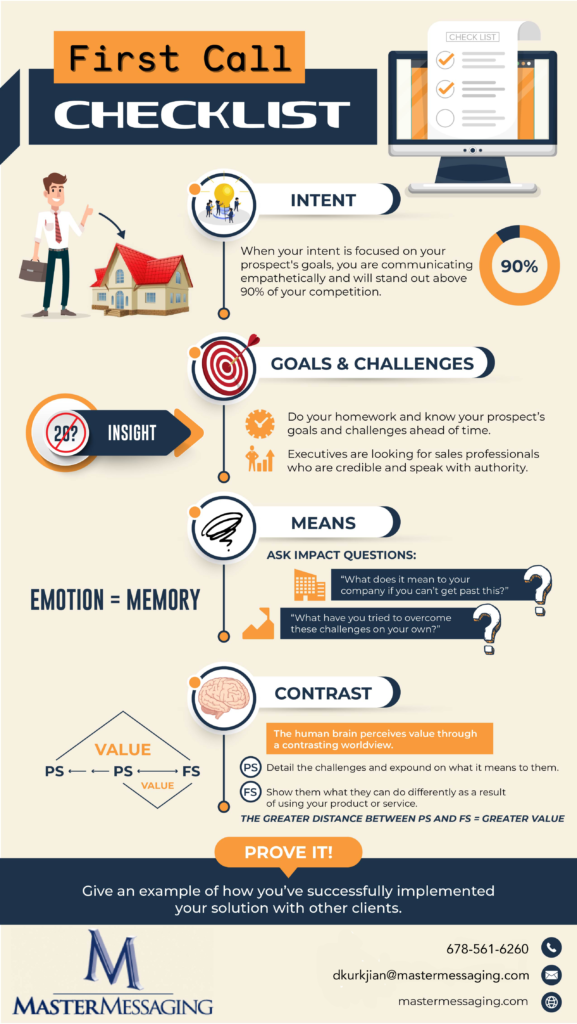
First Call Checklist- Infographic

**********

We understand it can be difficult to know where to start when developing a first conversation script, that’s why we’ve created a Sales Conversation Roadmap “Cheat Sheet” that you can download here.

**********

Most business owners have no extra time to devote to sales coaching. This is where MasterMessaging steps in and excels. We optimize your sales teams’ conversion rates, your lead volume, or both for less than the costs of a single administrative hire. The impact on your sales is significant and sustainable, continuing for years with no ongoing costs.

Our custom messaging solutions are strategically scripted, cadenced, and executed to increase conversion rates for maximum impact on your company’s revenue and profits. If needed we can also increase lead volume. Our system fits seamlessly with your existing sales process to ensure successful adoption & smooth rollout throughout your entire organization. Our solutions are high impact, low risk, minimally invasive, and integrate into your existing sales efforts.

Call: 678-643-9025, Email: dkurkjian@mastermessaging.com or instant message David Kurkjian on LinkedIn to start the conversation.