Improve Your Sales Conversations with Whiteboarding

See if this sounds familiar.

You’ve spent hours prospecting, you execute a discovery call, and then you’ve earned the right to a face to face or web meeting with your prospect. When you add up the time spent to get to this point, it’s substantial.

Here’s the problem. If you’re like most sales professionals and rely on PowerPoint to anchor the conversation, the prospect will only remember about 10% of what you say (John Medina, Brain Rules). If that’s the case, you just spent hours so that your prospect can forget 90% of what you said. That’s not a very good return on your time.

Now look at it from the prospect’s point of view. They meet with sales professionals all the time. I can only imagine what’s running through their minds. They get to sit through PowerPoint after PowerPoint and likely are being asked the same questions over and over again as the try to pick the right solution.

Pretty boring. Worse yet, all the sales conversations sound and look the same.

What does the prospect really want? According to Forrester Research, 88% of executive decision-makers want to have a conversation, not a presentation, for sales-related meetings.

With that as a backdrop, what if you could improve sales performance with:

  • 50 percent higher lead conversion rate
  • 29 percent shorter time-to-productivity
  • 15 percent shorter sales cycles

You can. According to Aberdeen research, these results can be realized through the use of Whiteboarding.

Here’s why:

  • A visual anchor to the conversation increases the retention rate to over 65% (John Medina, Brain Rules).
  • The progressive disclosure of content appeals to people’s curiosity and makes a lasting impression. White boards are superior to PowerPoint presentations, which lower levels of listener engagement and focus.
  • The element of novelty. At the moment, few sales professionals use white boards in their business deals, making this a powerful means of communication as it piques listeners’ curiosity. If you are different, you are more memorable.
  • The interactive nature of white boards. Stimulate people’s attention by asking for their active contribution while you are creating the white board; Collaborative work is always easier to remember, and more deeply engaging and meaningful for all participants.

If all of this is true, why don’t more sales professionals use Whiteboarding? It comes down to one huge hurdle: complexity. Most of the current approaches to whiteboarding are too complicated. If you look at the books, blogs, and videos on how to whiteboard in sales presentations, it’s enough to scare off even the most seasoned sellers.

So what’s the answer? Keep it simple and follow these tips:

  1. Start with the end in mind. What’s the most important Value Position you want your prospect to remember? Is it freedom to spend more time on more important projects? Increased efficiency? Reducing complexity? Find the central theme to the value you provide.
  2. Build a sales conversation from the prospect’s point of view that spotlights your Value Position. It’s easier to create a whiteboard when you already have the storyline.
  3. Pull out a clean sheet of paper and start drawing the story.
    • Use simple elements like geographic shapes, stick figures and graphs. This ensures that anyone can recreate the whiteboard, including your prospects and customers.
    • Use different colors and spatial orientation to create contrast in the whiteboard. Contrast “this is what your world looks like today” with “this is what your world could look like with our solution”. Colors: red is bad, green is good. Spatial orientation: down is bad, up is good.
    • Look at the finished whiteboard and check to see that it conveys the simple theme of the story. For example, if moving your prospects from a complicated world to a simple world, anyone looking at the visual should be able to quickly see this in the whiteboard.
  4. Whiteboarding is iterative. It will take several iterations before you find the final version. Use team members to help you with feedback.

Give whiteboarding a try. I’d love to hear your results.

********

I understand it can be difficult to know where to start when creating a Sales Conversation Roadmap. That’s why we’ve created a “Cheat Sheet” that you can download HERE.

If you’d like some help in increasing your revenue by closing more deals, reach out and let’s find a few minutes to chat on the phone. You can email me at dkurkjian@mastermessaging.com.


Increase Demo-to-Close Rates through High Value Demos

Let’s start with some hard cold facts.

Nobody cares about what your software (or product) does. On average, software customers only use 10% of the features.

So what do they care about? If you’ve been around as long as I have, think back to when Microsoft introduced Word, Excel and Powerpoint.

Microsoft Word could care less about how many fonts were included, the color options, italics, etc. Excel, again could care less about any of the formatting options. With PowerPoint, unless you were a power user, all the animations and transitions were rarely utilized.

The reason all 3 of these programs became part of our work world is because they addressed what people really cared about- Time Savings.

  • Word: Throw out the white-out. Just backspace and retype what you meant to type.
  • Excel: No need to enter numbers into a calculator for the same formula over and over again. Create one worksheet and enter the new numbers.
  • Powerpoint: Remember how hard and time consuming it was to create overhead slides? Create a series of slides and change them on the fly if needed.

Nobody bought or used these software programs for what they did. They bought them for an outcome called Time Savings.

That’s not to say there weren’t other outcomes.

  • Word: Save money on a personal assistant.
  • Excel: Reduce the number of accountants needed.
  • Powerpoint: Increase sales effectiveness (based on how some sales professionals use it today it would decrease sales effectiveness).

Understanding this dynamic, let’s look at some quick tips on how to deliver a high value software demonstration.


1. Challenges

What can’t your prospects do today without your software? What challenges can you help them overcome? What’s the negative impact of these challenges on key stakeholders in their business? Most of these questions should be answered in the discovery call (see our 5 point checklist).

2. Outcomes

What are the outcomes you create for your prospects? To get to the outcomes, ask this question on behalf of your prospect: “What can they do differently with your software that they can’t do today?”

3. Contrast

Armed with this information, focus the demo on outcomes that are a result of the things they can do differently with your software. But before you show them how they can do these things, ask them again to walk you through how they do it today. After they walk through the steps and experience the pain, show them simply how they can do it differently with your software.

This final step is where I see a lot of sales professionals missing the opportunity to reinforce the value the prospect experienced in the discovery call. Remember, value is perceived in a contrasting world view. You can recreate that contrasting world view during the demo by following step 3.

Here’s a quick example. A recent client that sells ERP software to small to mid-sized manufacturers was experiencing low conversion rates going from demo to close. When we walked through the 3 steps, here’s what they discovered.

Most of their prospects had accounting software like quickbooks. However, when they needed information about inventory, shipping, and customer orders they were using spreadsheets in conjunction with the information from quickbooks. The challenge was spending too much time to gather the information as well as inaccuracy based on the information living in different files. The impact was missed deadlines with clients that could lead to lost revenue.

Knowing this, before showing how all this information is at their fingertips in the ERP, they ask the prospect to walk them through how they get this information today. They then ask how this impacts their business. Finally, they show how easy and simple it is to track this information in the ERP, and tie that ability to increasing customer satisfaction and revenue.

Your software has value, otherwise you wouldn’t be in business today. But it’s on the sales team to communicate and demonstrate that value by focusing on the business outcomes first. Then show them how they can get those outcomes with your solution.

********

We understand it can be difficult to know where to start when trying to communicate value in every sales conversation. That’s why we’ve created an E-book on communicating value that you can download here.

If you’d like some help in increasing your revenue by moving more deals through your sales process, reach out and let’s find a few minutes to chat on the phone. You can email me at dkurkjian@mastermessaging.com.
Why Deals Get Stuck

I was recently having a conversation with a company that I partner with about where prospects get stuck in their sales process. As a marketing agency, they described a typical sales process to be discovery, expanded conversation, proof of concept and proposal. In the software world it be discovery call, demonstration, expanded conversation and proposal.

As they thought about a typical prospect, they found most deals stalled at the expanded conversation. It turns out this is also the stage where they discuss the typical cost of an engagement that ranges from $60k to $120k. They work with a lot of Private Equity firms and even when the PE firm referred them to the CEO of one of their portfolio companies, they would still lose traction once price was discussed.

Think about this for a moment. The PE firm has board members that work with the CEO. That represents a ton of credibility, and it still isn’t enough to move the deal to closure. I suspect that most of you don’t have that type of dynamic working in your favor.

Let’s look at what’s behind this from a human behavior standpoint. Whenever you sell a product or service to a prospect, you are directly asking them to change what they are doing today. Human beings for the most part are more comfortable with the status quo. We don’t like change because it represents something that is unknown to us. We also don’t like change because it requires time and effort to do something different.

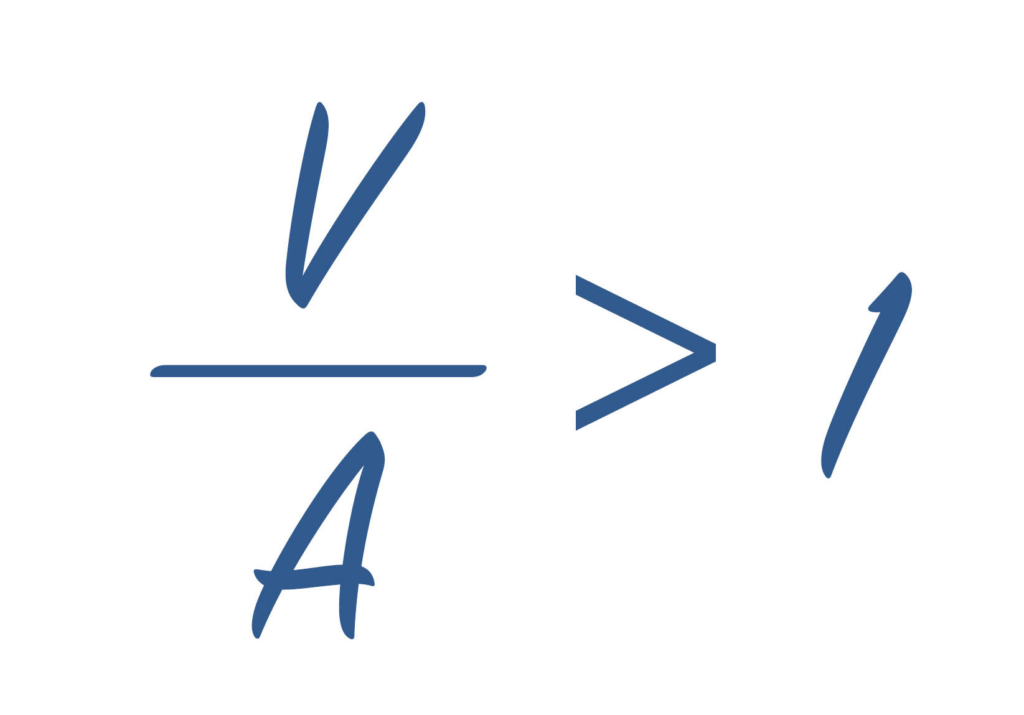
If humans are so resistant to change, how does anything ever get sold? The answer lies in this very simple formula.

Value (V) over the Ask (A) has to be greater than 1. The larger the number, the greater the likelihood of a sale.

This shows up in two ways.

First, when you get to the end of the sales process, the Value (V) that you are holding out to the prospect has to be greater than the Ask (A). Most people think that the ask is the price of the solution. While that’s true, another big part of the ask is the change that has to happen inside their business. Sometimes the change aspect is more difficult to overcome than the price. Stop and think for a moment, what does it take for your product or solution to be implemented in the world of your prospect?

The second place this dynamic shows up is in the sales process itself. Let’s go back to the partner company I referenced earlier. They are losing deals at the expanded conversation stage of their sales process. In our conversation, I introduced the formula that the Value (V) has to be greater than the Ask (A) as you move from one stage of the sales process to the next. I asked for their honest assessment- are you communicating high value in the expanded conversation stage or are you asking for too much to move to the next stage?

Knowing them, I suspected that value was not the problem. They agreed. The price tag at this stage in the relationship was too big of an ask to continue the conversation. I suggested that there may be a smaller ask that they could introduce before moving to closing an engagement. They thought for a moment and said they had been toying with the idea of doing a competitive diagnostic. Specifically do some light research to see how the prospects marketing and website compare to their top competitors. Doing this would increase the perceived value at this stage and the ask would be the prospect sharing some marketing materials to review.

Value (V) goes up and the Ask (A) goes down. This increases the potential for more deals to move into the latter stages of the sales process. (They are just starting this, stay tuned for an update.)

When looking at the conversion rates in your sales process, find the stage where most deals get stuck and apply this formula to that stage. It may not be a diagnostic, but there are other things you can use: Paid Proof of Concept (POC), assessments, road maps or a small step they can take to have an experience with you and your business.

These all represent ways to decrease the ask, but what about the Value (V) part of the equation? Are you communicating high value at each stage of the sales process? This is where we’ve helped out clients over the past 7 years by giving them a framework for communicating high perceived value to their prospects in every conversation, demo or proposal.

********

We understand it can be difficult to know where to start when trying to communicate value in every sales conversation. That’s why we’ve created an E-book on communicating value that you can download here.

If you’d like some help in increasing your revenue by moving more deals through your sales process, reach out and let’s find a few minutes to chat on the phone. You can email me at dkurkjian@mastermessaging.com.