Do SKO’s really help your team?

Your 2022 Sales Kickoff might just be the most important one you’ve ever had. The sales world has been changing more than ever, causing sales teams to run into problems daily. They have extra needs that need to be addressed, and leadership’s help in supporting them. As you begin preparing for your SKO, there are some important things you need to keep in mind in order to help set your team up for success.

Identify Needs

I had a conversation with a sales rep of a hyper growing b2b SaaS company the other day and asked him what he thought would be valuable to include in a SKO. The thing he stressed the most was that he wanted leadership to listen to what their daily challenges were and to come up with a plan on how to support the team in the future.

Sales reps are talking to customers all day, and a lot of times running into new problems they don’t have the time to solve. The thing is, you can’t roll the same thing out every year and expect it to stay relevant. This is a changing landscape, always keeping reps on their toes. They need new whitepapers, case studies, competitive analysis, product road maps, and value-based messaging throughout the year.

The first step is to address these needs. To get the discussion started, have your reps tell you one good thing that has worked in the last year, and one thing that hasn’t. Create an environment where they can be honest about what they need in order to be successful.

Create a Plan

Once you have identified your sales team’s needs for the new year, you have to make a plan to support those needs. It’s important that this plan is clearly laid out to your team so that they know what to expect and how they will be supported this next year.

This plan should include:

  • Marketing support
    Creation of new white-papers, sales decks, competitor analysis, etc.
  • Leadership support
    What can your reps expect from you moving forward? How will you communicate new solutions to them?
  • Customer Success support
    How they will help make the transition from prospect to client easier on the reps.
  • Additional training
    Bring an outside sales trainer to help the team stay up to date with new sales strategies.

Host Your SKO

Now that you have a plan in place, it’s time to throw a successful event. You can do this in person or virtually. Here are some suggestions on how to roll things out:

Make it fun

Kick things off with a happy hour! If you’re virtual, you could send your employees a cocktail kit and start the event off on a fun note. Making time for fun can help forge connections and boost company morale. The key is to not waste your rep’s time, so it might be useful just to include one short “fun” event before getting into the good stuff.

Celebrate Success

Highlight team members that have had great performance over the last year and make sure they feel valued. Talk through the successes of the company and point toward new goals that you have in the future.

Hire an Outside Sales Trainer

Consider hiring an outside sales trainer for a day-long workshop. Sometimes it can be hard to get through to your reps when teaching new concepts if you’ve been the one training and managing them all year. An outside perspective and authority can help them absorb concepts that they may not have been open to hearing previously.

Roll out New Solutions

This is the time to share the new solutions you have come up with to support your team. If you have a new product or offering, introduce it to the team along with all of the supporting materials they have to sell it. Remember, it’s imperative to set clear expectations on what your team can expect from you this next year. End it on a positive note where they are excited for the future and feel set up for success.

Now you are ready to throw an amazing sales kickoff, start your year off feeling confident in your team, and be excited about your company’s future success.

***********
If you are interested in investing in sales training for your SKO, we would love the opportunity to be a part of the discussion on how we can partner together to help you and your team achieve your goals. The content of our training workshops is taught by a 35-year sales veteran who specializes in elevating value by understanding the science of decision-making. Every rep will walk away with mastery of a conversation framework scientifically proven to communicate high value in every conversation they have with prospects and customers.

Why Focus on Value in 2021

One of the most important things to look over from year to year is not revenue goals, sales plans or staffing. It’s making sure your team is communicating the highest value specific to your product or service. During this time of making goals for the new year, it can be hard to focus on something as specific as what your sales reps are communicating in their sales conversations. But what’s ultimately going to make you more revenue is more sales- and to get more sales you need successful sales reps who communicate value in their conversations.

When talking with other sales professionals, I hear that it can be challenging to get prospects to move past the expanded conversation part of the sales process. This is typically when there’s a discussion about price.

Let’s look at what’s behind this from a human behavior standpoint. Whenever you sell a product or service to a prospect, you are directly asking them to change what they are doing today. Human beings for the most part are more comfortable with the status quo. We don’t like change because it represents something that is unknown to us. We also don’t like change because it requires time and effort to do something different.

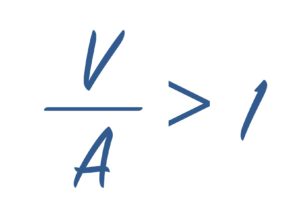
If people are so resistant to change, how do you communicate high enough value to gain a sale? We’ve created a simple formula to explain how it works.

The Value (V) over the Ask (A) has to be greater than 1. The larger the number, the greater the likelihood of a sale.

The Value (V) has to be greater than the Ask (A) as you move from one stage of the sales process to the next. Are you communicating high value in the expanded conversation stage or are you asking for too much to move to the next stage? This is where many reps find themselves getting stuck.

When you get to the end of the sales process, the Value (V) that you are holding out to the prospect has to be greater than the Ask (A). Most people think that the Ask is the price of the solution. While that’s true, another big part of the Ask is the change that has to happen inside their business. Sometimes the change aspect is more difficult to overcome than the price. Stop and think for a moment, what does it take for your product or solution to be implemented in the world of your prospect?

When looking at the conversion rates in your sales process, find the stage where most deals get stuck and apply this formula to that stage. It may not be a diagnostic, but there are other things you can use: Paid Proof of Concept (POC), assessments, road maps or a small step they can take to have an experience with you and your business.

These all represent ways to decrease the ask, but what about the Value (V) part of the equation? Are you communicating high value at each stage of the sales process? This is where we’ve helped out clients over the past 10 years by giving them a framework for communicating high perceived value to their prospects in every conversation, demo or proposal.

We are now offering a way in which prospects can tangibly see the value of your product or service by using a business case tool. This tool highlights the value and benefits of your product while also providing the financial justification in the form of an ROI. It can be used to prospect, accelerate sales and ensure high client retention.

If you’d like some help in increasing your revenue by moving more deals through your sales process, reach out and let’s find a few minutes to chat on the phone. You can email me at dkurkjian@mastermessaging.com.

*********

We understand it can be difficult to know where to start when trying to communicate value in every sales conversation. That’s why we’ve created an E-book on communicating value that you can download here.

The “Why” in Sales

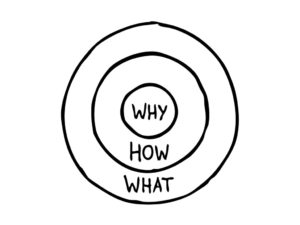
In his book, Start with Why, Simon Sinek unpacks why some companies have wild success in the face of stiff competition. As a noted marketer, years ago he decided to decode why some companies have more success in a commoditized market. This led to the creation of the “golden circle” seen below. 

What Simon found is that most companies are clear on what they deliver in the way of a product or service and how they go about doing that. But what he discovered is that it’s the most successful companies that are clear about why they are in business.

Why

Let’s look at the story behind Starbucks as an example. Howard Schultz, the CEO and founder of Starbucks, took a trip to Italy back in the 70’s. During that trip he experienced the amazing culture of the Italians, especially the prevalence of cafes wherever he traveled. What he learned is that the Italians have three places where they hang out: Home, work and the cafes. The cafes are a place where the community gathers throughout the course of the day to hang out with friends and family over coffee, snacks or later in the day, wine. The cafes are the third place where Italians spend time.

During his travels in Italy, Howard Schultz decided to create a third place to spend time in the United States: A place for people to hang out and socialize in much the same way that they do in the cafes in Italy. It’s interesting in Starbucks establishing their why, the focus was not on selling more coffee than any other coffee shop in the US. Everybody within Starbucks from the CEO on down is very clear about their why. It is to create an environment for people in the US to experience community in the form of a coffee shop. The coffee and other things that are sold are merely there to help create this environment. 

So how does the why of a company impact the selling conversations that you have with your prospects and customers? Just like the why in your business is an indicator of success in the business world, there’s a corresponding word that is an indicator of success in the selling conversations that you have with your prospects and customers.

Meaning

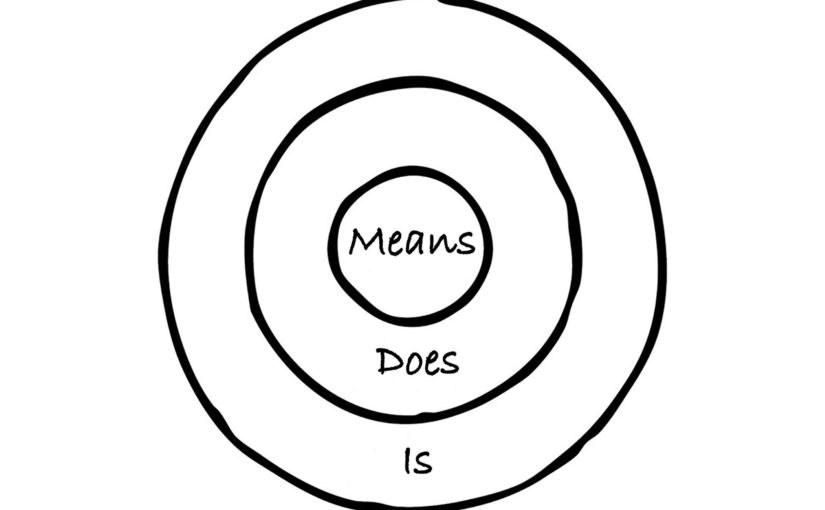
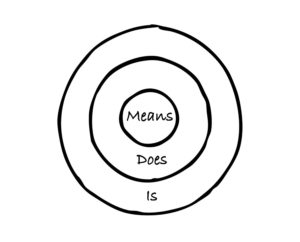
The word is means or meaning.  There’s a similar diagram you can use to ensure that you’re clear on what your product means for your prospect or customer. See the diagram below.

Instead of why, how and what, the conversation in the Golden Circle is Means, Does and Is. Just like being clear about your why is an indicator of success for your company’s product or service, being clear on what your product means to the prospect or customer will create success in the conversations that you’re having with your prospects and customers. 

Meaning is derived or experienced by your prospects and customers when you communicate outcomes that will make a difference in their work and lives. Outcomes have meaning and meaning has corresponding emotions associated with them.

Value Position Statements

In order to communicate this meaning, you need to create a Value position statement(VPS). The basic elements that go into creating a value position are: Specific challenges that your prospect or customer may face, your unique ability to solve those challenges and the ability to demonstrate or prove that you can solve the challenges.

The first step is being very clear about your ideal customer persona (ICP). Then once you’ve identified common challenges that your ICP faces, now is the time to identify your unique ability to address these challenges. If you’re like a high number of sales professionals, you may be struggling with identifying something that’s unique to your product or service. It’s understandable, given we live in a commoditized world. However, if you look deep enough, you can typically find an element to your product or service that really is unique. 

If you are unable to identify something that is truly unique, then work with something that represents a strength. Specifically, identify the reason that you win more deals than not. That reason can be used in place of something that is truly unique. Obviously you want to focus the conversation on a strength that has created success for you in the past. 

Once you have created your VPS, it’s important to follow a framework, or playbook, during sales conversations so that you can successfully communicate your meaning and the value you provide in every conversation you’re having with prospects. We’ve created a checklist you can reference HERE.

If you’d like some help in increasing your revenue by closing more deals, reach out and let’s find a few minutes to chat on the phone. You can reach me at dkurkjian@mastermessaging.com or 678-561-6260.

**********

We understand it can be difficult to know where to start when developing a first conversation script. That’s why we’ve created a Sales Conversation Roadmap “Cheat Sheet” that you can download here.

The Science Behind Selling

How Hormones Affect Our Sales

We’ve learned a lot over the last few years about the science and biology involved in a selling conversation. The insights provided by science are important, as Sirius Decisions in their 2017 buying study learned that 33% of over 1,000 B2B executives surveyed said the most important content or message was the sales conversation. This was the highest number by far.

If you’ve followed any of our previous blogs, you know that science has proven that human beings make buying decisions based on meaning and emotion, then justify those decisions with logic and reason. What you may not know are the hormones involved in this human equation. More importantly, how they can help or hurt you in your relationships with your prospects and customers.

Remember the infamous scene in Glengarry Glen Ross where the ABC’s of selling are introduced? “Always Be Closing!” It makes for a nice line in a movie, but in practice it will cause the release of a hormone that will have the opposite effect of closing a deal.

Cortisol- The Stress Hormone

When this hormone is present in a fight or flight situation, it’s a good thing. It prepares our central nervous system for immediate action. When it’s present in your prospect or customer, it’s a bad thing. Asking premature closing questions will cause stress in your prospect. Taking control of the conversation in a way that your prospect feels manipulated will also cause stress. There are a number of behaviors that invite the presence of Cortisol into your conversation.

When this happens, your prospect will be closed off to new ideas or ways of doing things. They stop listening. They won’t hear most of what you say as they are trying to figure out how to get out of the conversation. The only time that Cortisol is a good thing is when you are discussing the pain of their current situation. Just don’t leave them there. Make sure you paint a picture of a better world with your product or service before you conclude the conversation.

The next hormone is also very familiar and is largely responsible for smart phone screen addiction.

Dopamine

It is a short duration feel-good hormone. Any time our smartphone beeps or buzzes, we get a little dose of dopamine. We feel important- someone liked our Facebook posts or sent us an email. This behavior is so dominant it can cause a phantom vibration from a phone that isn’t even in your pocket or purse.

Dopamine shows up in a selling conversation as your prospect agrees to next steps or eventually signs the contract. The only problem is that you are experiencing Dopamine, but your prospect is experiencing Cortisol. As they consider the uncertainty of the engagement and the changes they’ll have to make, Cortisol is released and they experience stress.

Oxytocin

The hormone that you want present in any selling relationship is the trust hormone, Oxytocin. Oxytocin is present in the highest concentration when a mother gives birth to her child. Oxytocin floods both the mother and baby at birth to create a tight initial bond.

How can you create the release of Oxytocin in your prospect or customer? There are a number of ways this can happen.

Human Contact

Any time you make contact with another human being, Oxytocin is released. This can be a handshake, hug, and even eye contact, to a certain degree. Ideally you want to make eye contact in a conversation about 70% of the time. Go over that and it starts to get creepy. Mirroring is another way to create Oxytocin in the relationship. Find ways to mirror your prospect with body language and speech patterns.

Intent

However, the number one way to ensure Oxytocin is present in a selling conversation is to make sure your focus is on the prospect. When human beings believe that someone else has their best interest in mind, that’s when Oxytocin is at its highest.

The best way to ensure you have this intent is to answer this question: How is your prospect going to be better off as a result of doing business with you? If that is your intent and focus, you’ll build strong trustworthy relationships with your prospects and customers.

Understanding the science behind selling leads to a clearer picture of how to frame your messaging to your prospects. We understand it can sometimes be difficult to know where to start when building a framework for sales conversations, so we’ve developed a Sales Conversation “Cheat Sheet” you can download HERE.

Call: 678-561-6260, Email: dkurkjian@mastermessaging.com or instant message David Kurkjian on LinkedIn to start the conversation.